
ECG product directory
ECG Cables & Leadwires Manufacturer
JYCMED manufactures four main ECG cable categories for patient monitoring, diagnostic and ambulatory recording equipment: ECG trunk cables, ECG leadwires, integrated ECG cables and Holter ECG cables. OEM configurations are developed according to the device connector, pinout, lead system and clinical application.
ECG Cable Product Range
Select the cable architecture that matches your monitoring device and patient-side connection.

Monitor-side main cable
ECG Trunk Cables
Reusable main cables connecting patient monitors to detachable ECG leadwire sets. They are commonly used with bedside and multi-parameter monitoring systems.
- 3, 5, 10 or 12-lead configurations
- Custom monitor connector and pin assignment
- Shielding, cable length and strain-relief options

Patient-side lead set
ECG Leadwires
Flexible patient-side leads connecting ECG electrodes to a trunk cable or directly to a monitoring device. Reusable and disposable constructions are available.
- Snap, clip, pin and custom electrode terminations
- AHA, IEC or approved customer color coding
- Flexible, low-noise cable structure options

One-piece cable assembly
Integrated ECG Cables
All-in-one cable assemblies combining the monitor-side cable and patient leadwires. The one-piece structure reduces intermediate connection points.
- Integrated trunk cable and leadwire construction
- Suitable for compact and portable ECG equipment
- Custom connector, lead count and molded junctions
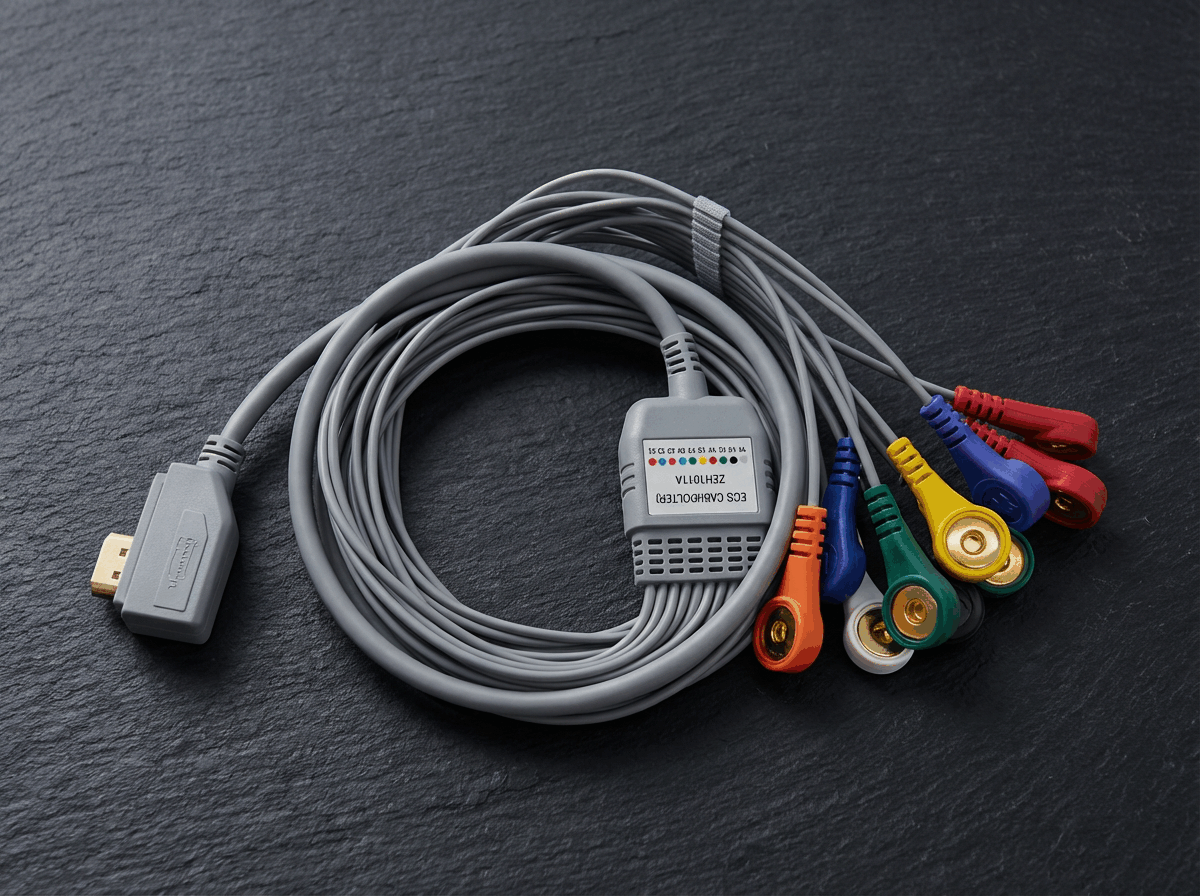
Ambulatory recording cable
Holter ECG Cables
Lightweight cable assemblies for portable Holter recorders and extended ambulatory ECG monitoring where flexibility and movement-noise control are important.
- Recorder-specific connector and pinout options
- Lightweight and flexible patient-side leads
- Custom lead set, cable length and labeling
Quick selection guide
How Are the Four ECG Cable Types Different?
ECG trunk cable: connects the monitor to a detachable leadwire set.
ECG leadwire: connects the trunk cable or device to patient electrodes.
Integrated ECG cable: combines the trunk cable and leadwires into one assembly.
Holter ECG cable: connects a portable recorder to electrodes for ambulatory recording.
Compatibility notice: ECG cables are not universally interchangeable. Confirm the device model, connector, pinout, lead count, electrode termination and AHA or IEC color standard before ordering.
ISO 13485 manufacturing
Quality-Controlled ECG Cable Manufacturing
JYCMED manufactures custom ECG cables and leadwires under an ISO 13485 quality management system. OEM configurations can include custom monitor connectors, pin assignments, lead counts, AHA or IEC color coding, cable materials and molded strain relief. Production controls cover incoming material inspection, in-process verification, electrical continuity testing, insulation testing and batch traceability.
- ISO 13485Quality management
- 100% Electrical TestingContinuity and insulation
- Batch TraceabilityMaterials to finished goods
- OEM Configuration ControlConnector, pinout and lead system
OEM buyer questions
ECG Cable FAQ
Can JYCMED manufacture custom ECG cables for OEM devices?
Yes. Custom options include the monitor connector, pinout, lead configuration, electrode termination, conductor, shielding, jacket material, length, color coding, overmolding, labeling and packaging.
What information is needed to confirm ECG cable compatibility?
Provide the monitor manufacturer and model, connector photo or sample, pinout if available, lead count, electrode type, cable length, AHA or IEC standard and target application.
Are reusable and disposable ECG leadwires both available?
Yes. The appropriate construction depends on clinical workflow, cleaning requirements, expected service life, infection-control strategy and applicable product requirements.
What quality controls are used for OEM ECG cable production?
Controls can include incoming material inspection, in-process assembly verification, electrical continuity and insulation testing, final inspection and batch-record traceability according to the approved product specification.