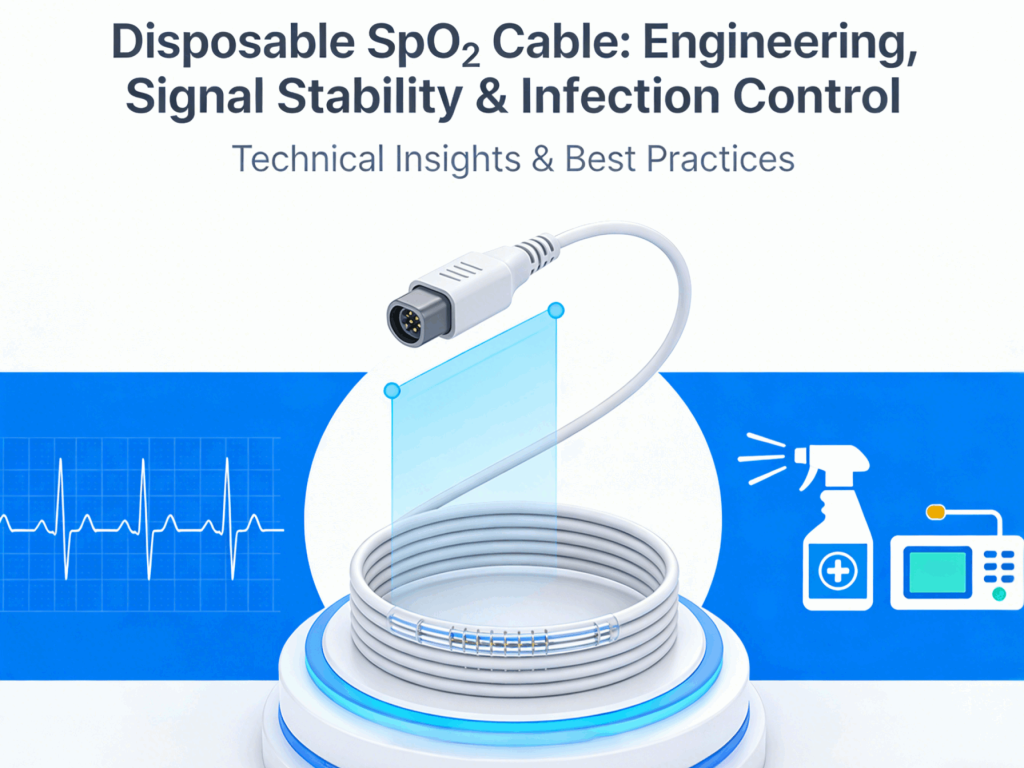
Disposable SpO₂ cable solutions have become a staple in modern clinical settings, where strict infection control and streamlined workflow efficiency are non-negotiable. But from an engineering standpoint, these cables are far more than just low-cost alternatives to reusable designs. They demand meticulous optimization to guarantee signal accuracy, electrical stability, and mechanical safety for their intended single-patient use.
In this post, we’ll break down the core design principles of disposable SpO₂ cables, key engineering considerations for developers, and the clinical and economic scenarios where these single-use solutions make the most sense.
What Is a Disposable SpO₂ Cable?
A disposable (or single patient use) SpO₂ cable is engineered for short-term oxygen saturation monitoring of a single patient and is discarded post-use in line with hospital infection control protocols.
Typical System Configurations
- Standard setup: Monitor → Extension Cable (optional) → Disposable SpO₂ Sensor → Patient
- Compact system setup: Monitor → Disposable Integrated SpO₂ Cable → Patient
Unlike reusable SpO₂ cables, disposable versions are designed with four core priorities:
- Full infection control compliance
- Reduced reprocessing labor for hospital staff
- A controlled, reliable performance lifecycle
- Simplified hospital logistics and inventory management
This focus makes them the go-to choice for high-risk clinical environments.
Why Infection Control Drives Demand for Disposable SpO₂ Cables
Hospital-acquired infections (HAIs) remain a critical operational and patient safety concern for healthcare facilities worldwide. Reusable SpO₂ cables introduce multiple layers of risk and cost due to their required reprocessing workflow:
- Mandatory cleaning and chemical disinfection
- Dedicated handling by biomedical staff
Each step in this reprocessing process creates tangible challenges:
- Increased labor costs for the hospital
- Higher risk of human error (e.g., incomplete disinfection)
- Gradual surface degradation of the cable over repeated use
Disposable SpO₂ cables eliminate cross-patient contamination risks entirely by design—they are never reused. This makes them particularly well-suited for high-risk care areas including:
- Isolation wards
- Operating rooms
- Emergency departments
- Infectious disease units
For hospital procurement teams, the decision to adopt disposable cables is rarely based on unit price alone; it’s driven by the total workflow cost and risk reduction they provide.
Engineering Challenges in Designing a Disposable SpO₂ Cable
While disposable SpO₂ cables are intended for short-term use, they must maintain unwavering stable optical signal transmission—this is non-negotiable for accurate pulse oximetry. SpO₂ monitoring relies on precise measurement of two key light wavelengths:
- Red light (approximately 660nm)
- Infrared light (approximately 940nm)
Any instability in signal transmission can lead to critical clinical inaccuracies, including:
- Incorrect oxygen saturation readings
- Amplified motion artifacts
- Intermittent waveform dropouts
Disposable design does not equal simplified engineering. Below are the three most critical engineering challenges developers must address:
1. Conductor Resistance Balance
Uneven conductor resistance is a major design pitfall, as it can cause:
- Signal distortion
- Inconsistent LED drive current
- Reduced overall sensor accuracy
Even for single-patient use, tight tolerance control for conductors is an essential design requirement.
2. Shielding and EMI Resistance
Hospital environments are filled with electromagnetic interference (EMI) sources, such as:
- Electrosurgical units
- Ventilators
- Multiple patient monitors
- Mobile medical carts
Poor shielding in a disposable SpO₂ cable can lead to significant signal issues:
- Pulse waveform noise
- Complete signal dropout
- Fluctuating SpO₂ values
Proper twisted pair conductor structures and basic shielding are therefore non-negotiable, even for short-term use cables.
3. Mechanical Stability Under Patient Movement
Even during short-term monitoring, disposable cables are subjected to constant physical stress from:
- Bed repositioning
- Patient hand/limb movement
- Monitor repositioning
Key mechanical design considerations to prevent failure:
- Robust strain relief at the sensor-cable joint
- Intact overmolding for structural integrity
- Controlled flexibility (not too stiff, not too fragile)
In poorly designed disposable SpO₂ cables, failure almost always occurs at the joint transition area—not the conductor core itself.
Disposable vs. Reusable SpO₂ Cables: Engineering Trade-Offs
The fundamental engineering difference between disposable and reusable SpO₂ cables lies in lifecycle design. Each is optimized for its intended use case, with no one-size-fits-all solution.
Reusable SpO₂ Cable Design Traits
- Engineered for repeated cleaning and disinfection
- Requires high chemical resistance
- Tolerates a high number of bending cycles
- Uses thicker, more durable materials
Disposable SpO₂ Cable Design Traits
- Optimized for a defined, short operational lifecycle
- Balanced material cost (without sacrificing performance)
- Lighter, more compact structure
- Laser-focused on stable performance for the intended monitoring period
How to Choose the Right Cable
The decision between disposable and reusable SpO₂ cables hinges on specific clinical and operational factors:
- Length of patient monitoring duration
- Hospital/unit infection control policies
- Care setting (ICU vs. emergency department vs. general ward)
- Use case (in-hospital care vs. homecare)
Crucially, disposable SpO₂ cables are not replacements for reusable ones—they are scenario-based engineering solutions that address specific clinical needs.
Common Failure Points in Disposable Pulse Oximeter Cables
Understanding the typical weak points of disposable SpO₂ cables helps OEM device manufacturers make better development decisions and reduce field return risks. The most frequent failure areas are:
- Sensor-to-cable junction (the most common failure point)
- Unstable connector crimps
- Insufficient EMI shielding
- Excessive conductor thinning (to cut costs, compromising performance)
Early collaboration between OEM device teams and specialized cable engineers is the best way to mitigate these risks and design a reliable disposable SpO₂ cable.
FAQ: Disposable SpO₂ Cables
Q1: Is a disposable SpO₂ cable less accurate than a reusable one?
Accuracy depends on signal design and conductor stability—not reusability. A properly engineered disposable SpO₂ cable will deliver stable, accurate readings for its entire intended usage period.
Q2: When should a hospital choose a single patient use SpO₂ cable?
When the risks of infection, high reprocessing labor costs, or the complexity of cleaning workflows outweigh the long-term cost benefits of reusable cables.
Q3: Does a disposable SpO₂ monitoring cable require shielding?
Yes. Hospital environments contain abundant EMI sources even for short-term monitoring. Basic shielding is a must to ensure consistent signal stability.
Q4: Are disposable pulse oximeter cables ISO 13485 compliant?
They should be manufactured under ISO 13485 quality management systems. This ensures strict process control, product traceability, and comprehensive quality documentation—critical for medical device compliance.