
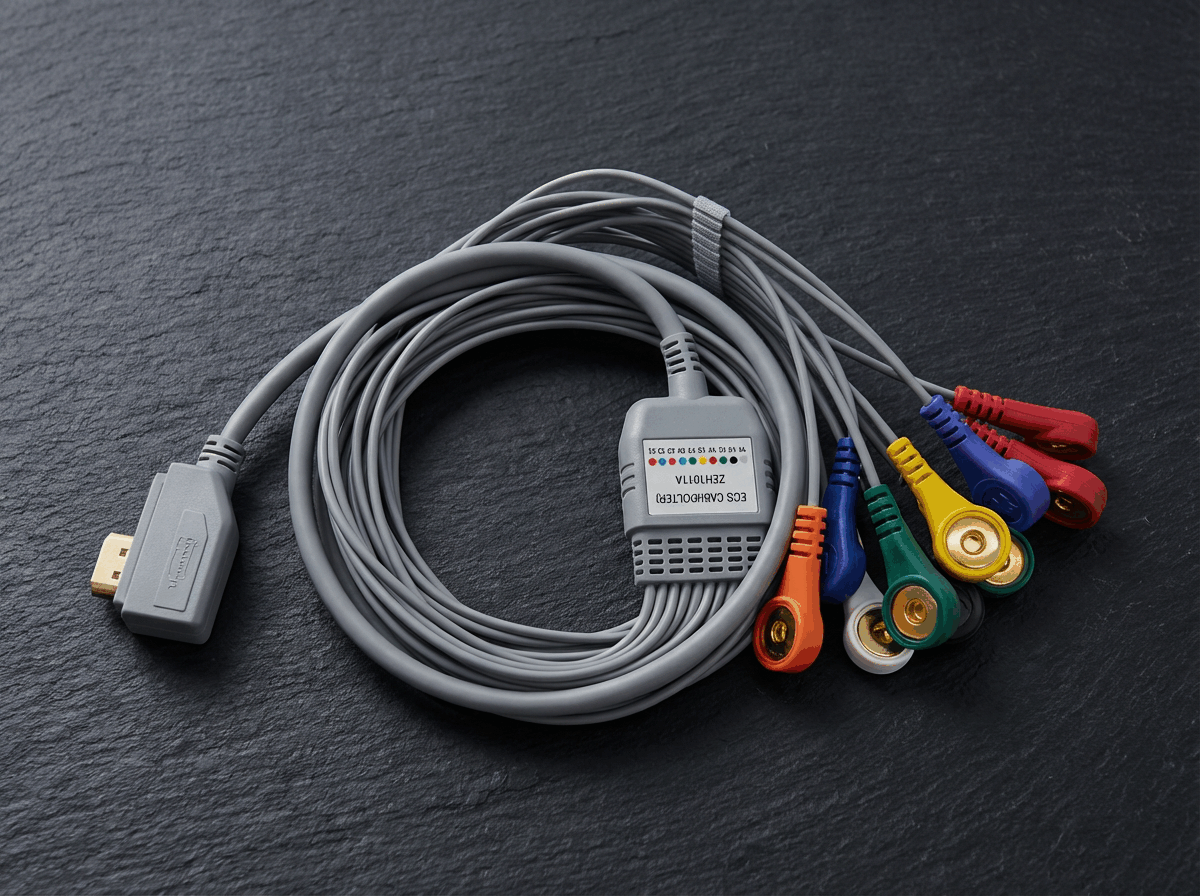
Overview
A Holter ECG cable is a patient-side cable designed for long-term ambulatory ECG monitoring, commonly used with Holter recorders, portable ECG monitors, and wearable ECG devices.
It is engineered to maintain stable, low-noise ECG signal transmission during continuous patient movement, ensuring accurate data collection over extended monitoring periods (24–72 hours).
These cables are essential for wearable ECG systems, remote patient monitoring (RPM), AI-based cardiac diagnostics, and home healthcare applications.
Specifications
| Parameter | Specification |
| Conductor Material | Silver-plated copper / Tinned copper |
| Resistance | ≤ 1 kΩ (typical) |
| Capacitance | Low capacitance design for ECG signal fidelity |
| Noise Performance | Optional semi-conductive coating for triboelectric noise reduction |
| Signal Integrity | Stable for 24–72h continuous monitoring |
| Wire Gauge | AWG 30–32 |
| Conductor Structure | Ultra-fine multi-stranded conductor |
| Jacket Material | Medical-grade TPU / Silicone |
| Outer Diameter | ≤ 2.2 mm |
| Bending Life | ≥ 150,000 cycles |
| Weight | Lightweight optimized |
| Strain Relief | Reinforced |
Equipment Compatibility
Compatible with Holter & Wearable ECG Systems
Our Holter ECG cables are designed for seamless integration with:
•Holter ECG monitoring devices
•Portable ECG recorders
•Wearable ECG monitoring systems
•Home-based ECG monitoring devices
•AI-driven ECG analysis platforms
✅ OEM / ODM Customization Available
We support full customization based on your device requirements:
•Connector type & pin configuration
•Signal architecture & shielding design
•Cable length & structure
•Electrode interface (snap / tab / pin)
Main Functions
Core Functions of Holter ECG Cables
•Reliable ECG signal transmission during long-term monitoring (24–72 hours)
•Stable signal performance during daily patient activities
•Reduction of motion artifacts and electrical noise
•Lightweight and flexible connection for wearable comfort
Key Features
Key Features of Our Holter ECG Cable
•Ultra-low motion noise design for ambulatory ECG monitoring
•Lightweight and highly flexible structure for long-term wear
•High bending life (≥150,000 cycles) for durability
•Skin-friendly materials (medical TPU / silicone)
•Stable signal transmission over extended monitoring periods
•Optimized for continuous 24–72 hour ECG recording
•Compatible with multiple electrode interfaces (snap / tab / pin)
•Fully customizable for OEM ECG device manufacturers
Compatible Systems & Brands
Compatible with Major ECG Brands & OEM Platforms
Our Holter ECG cables can be designed to match:
•Philips Holter systems
•GE Healthcare ECG devices
•Mindray portable ECG monitors
•Nihon Kohden ECG systems
•Schiller / Mortara / Spacelabs Holter devices
👉 We also support customization for:
•Wearable ECG startups
•AI ECG platforms
•Remote monitoring device manufacturers
Applications
Real-World Use Case
In a wearable ECG monitoring system, patients continue daily activities while wearing a Holter recorder.
Our low-noise, lightweight Holter ECG cable ensures:
•Stable ECG signal acquisition during movement
•Reduced motion artifacts
•Improved diagnostic accuracy
Quality & Compliance
Medical Quality & Compliance Standards
Our Holter ECG cables are manufactured under strict medical-grade standards:
•ISO 13485 certified manufacturing system
•Designed according to IEC 60601-1 safety standards
•EMC compliance (IEC 60601-1-2)
•RoHS & REACH compliant materials
•Biocompatible materials for patient contact
Why Choose Us
Why Choose Our Holter ECG Cable Solutions?
•Professional manufacturer of ECG cable assemblies
•Strong OEM / ODM capability for wearable ECG devices
•Expertise in low-noise ECG signal transmission
•Proven experience in Holter and remote monitoring systems
•Flexible customization for connectors, materials, and structure
•Fast prototyping (2–3 weeks)
•Scalable production for medical OEM projects
👉 We help device manufacturers develop high-performance, low-noise ECG connectivity solutions for real-world patient movement scenarios.
FAQ
What is a Holter ECG cable used for?
A Holter ECG cable is used for long-term ambulatory ECG monitoring, typically in wearable or portable ECG devices that record heart activity over 24–72 hours.
What is the difference between a Holter ECG cable and a standard ECG cable?
Holter ECG cables are designed for continuous monitoring during daily activity, with a focus on:
•Motion noise reduction
•Lightweight design
•Long-term comfort
Standard ECG cables are mainly used in clinical or bedside monitoring.
How to choose the best Holter ECG cable?
When selecting a Holter ECG cable, consider:
•Low motion noise performance
•Cable flexibility and weight
•Compatibility with your ECG device
•Patient comfort for long-term wear
👉 Choosing the right cable improves signal accuracy and diagnostic reliability.
What causes noise in Holter ECG monitoring?
Common causes include:
•Patient movement
•Cable friction
•Poor shielding design
Using a low-noise, well-shielded Holter ECG cable significantly reduces signal interference.
Are Holter ECG cables compatible with wearable ECG devices?
Yes. Holter ECG cables are widely used in:
•Wearable ECG monitors
•Portable ECG recorders
•Remote patient monitoring systems
They are specifically designed for dynamic, real-world movement conditions.
Can Holter ECG cables be customized for OEM devices?
Yes. Professional manufacturers offer OEM/ODM services including:
•Connector types and pin configurations
•Cable length and structure
•Electrode interfaces (snap / tab / pin)
•Shielding and material optimization
What is the best cable for wearable ECG monitoring?
The best cable should be:
•Lightweight and flexible
•Low-noise and motion-resistant
•Comfortable for long-term wear
Holter ECG cables are specifically designed to meet these requirements.
What is the difference between Holter ECG cable and ECG leadwire?
•Holter ECG cable connects the device to the patient system
•ECG leadwire connects electrodes to the cable
Both are essential parts of a complete ECG monitoring system.
How long can a Holter ECG cable be used continuously?
Holter ECG cables are designed for continuous use over 24–72 hours, depending on the monitoring system and application.
Which industries use Holter ECG cables?
Holter ECG cables are widely used in:
•Medical device manufacturers
•Wearable health technology companies
•Remote patient monitoring providers
•Hospitals and diagnostic centers