What Is an Integrated ECG Cable?
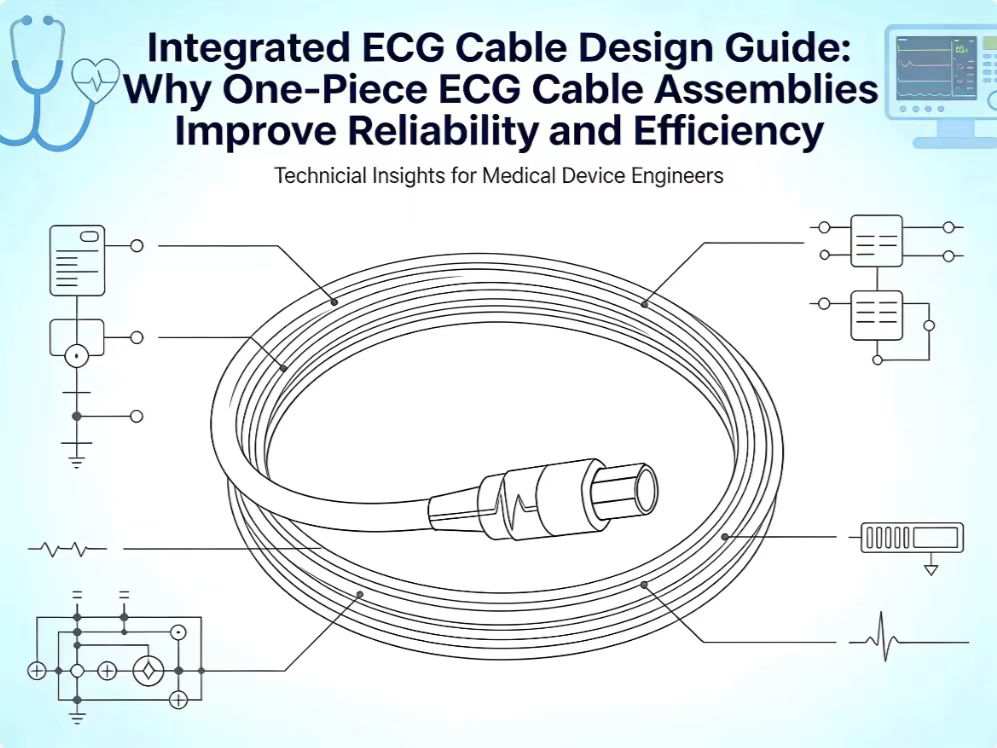
An integrated ECG cable (also called a one-piece ECG cable or integrated trunk cable) is a single unified assembly that combines four core components into one structure:
- ECG trunk cable
- ECG leadwires
- Patient-side connectors
- Monitor-side connector
Unlike traditional modular ECG systems—where trunk cables and leadwires are separable—integrated ECG cables eliminate all intermediate connection points, creating a simplified system structure:
Traditional ECG system: Monitor → Trunk cable → Leadwire set → Electrodes
Integrated ECG system: Monitor → One-piece ECG cable → Electrodes
This structural simplification has a direct, significant impact on signal stability, mechanical durability, and clinical infection control.
Why Integrated ECG Cables Are Becoming Popular in Modern Monitoring Systems
Modern healthcare device design is driven by four key goals, and integrated ECG cables align perfectly with each:
- Compact equipment structure
- Reduced connection failure rates
- Simplified cleaning and disinfection workflows
- Lower long-term maintenance costs
The core advantages of integrated ECG cable assemblies that drive their growing adoption:
- Fewer electrical contact points throughout the system
- Reduced intermittent signal issues and waveform distortion
- Lower risk of leadwire detachment during clinical use
- Simplified handling for medical staff
For medical device OEMs, integrated ECG cable design also enhances the perceived reliability of the entire monitoring system for end users.
Engineering Advantages of Integrated ECG Cable Assemblies
The benefits of integrated ECG cables extend far beyond structural simplicity—they directly boost the electrical and mechanical performance of ECG monitoring systems. Here are the key engineering advantages:
1. Reduced Contact Resistance and Signal Loss
Traditional modular ECG systems introduce performance risks at every interface, including:
- Unwanted contact resistance
- Oxidation of connector pins over time
- Signal instability from micro-movement of connections
An integrated ECG cable removes the trunk-to-leadwire connectors and snap junction variability, which:
- Lowers cumulative system resistance
- Improves ECG waveform stability
- Delivers cleaner baseline signals for high-sensitivity monitoring devices
2. Improved Mechanical Reliability
Repeated plugging and unplugging of modular trunk and leadwire connectors is a common cause of clinical equipment failure, leading to:
- Excessive connector wear
- Locking mechanism failure
- Bent or deformed connector pins
A one-piece integrated ECG cable assembly solves these issues by:
- Eliminating all intermediate mating cycles
- Reducing mechanical failure points
- Boosting long-term durability
This benefit is especially valuable in high-turnover clinical environments (e.g., emergency departments, general wards) with frequent equipment use.
3. Better Infection Control Strategy
Most integrated ECG leadwire assemblies are engineered for single-use or simplified replacement, with common designs including:
- Disposable integrated ECG cables
- Semi-disposable patient cable assemblies
Since the entire patient-contact section can be replaced in one step, the risk of cross-contamination between patients is significantly reduced—simplifying infection control workflows in sensitive clinical departments (e.g., ICUs, neonatal units).
4. Cleaner Cable Management
Integrated ECG cables streamline clinical equipment setup and use by reducing:
- Cable tangling and clutter at the bedside
- Risk of lead misconnection (a common source of diagnostic error)
- Assembly confusion for medical staff
This design is particularly beneficial for compact bedside monitors and transport ECG devices, where space is limited and quick setup is critical.
Design Considerations for Integrated ECG Cable Manufacturing
While integrated ECG cables offer substantial benefits, precision design and manufacturing are non-negotiable to ensure performance. Key considerations for engineers and manufacturers include:
Conductor Structure and Resistance Balance
Integrated systems still require the same strict electrical performance standards as modular designs, including:
- Equal conductor resistance across all leads
- Stable impedance control throughout the cable
- High-quality copper or silver-plated copper conductors
Long cable routing (common in clinical settings) must maintain uniform signal integrity, and 100% electrical testing of every unit is recommended to ensure compliance.
Shielding Strategy
Electromagnetic interference (EMI) protection remains critical for integrated ECG cables, especially in busy hospital environments with multiple electronic devices. Common shielding options include:
- Spiral shielding
- Foil shielding
- Combined shield structures (spiral + foil)
Integrated ECG cables used in ICUs or transport systems must maintain signal clarity even in the most electromagnetically complex clinical settings.
Overmolding and Strain Relief Design
Since the entire ECG leadwire assembly is molded as a single piece, precision in this step is critical to prevent long-term failure:
- High-precision injection molding for seamless connections
- Strain relief design that distributes pull force evenly across the cable
- Smooth junction transitions to avoid conductor fatigue and breakage
Poor strain relief design is a top cause of internal conductor breakage in one-piece cables, making this a non-negotiable design element.
Monitor Compatibility and Custom Connector Design
OEM medical device projects often require customized integrated ECG cables to match unique equipment specifications, including:
- Custom pin layout for monitor-side connectors
- Specific locking systems for secure attachment
- Branding on cable overmold
- Custom cable length for different clinical use cases
Top integrated ECG cable manufacturers support flexible customization while maintaining strict ISO-compliant production processes.
Integrated ECG Cable vs Traditional Modular ECG Cable: Key Design Trade-Offs
Most ICU and high-end bedside monitoring systems still use traditional modular ECG structures, while integrated cables are increasingly adopted for specific device categories. The choice is not about “better or worse”—it depends on system design priorities. Below is a critical engineering comparison of the two approaches:
1. Mechanical Reliability
| Modular ECG Cable | Integrated ECG Cable |
| Additional trunk-to-leadwire connection interface | No intermediate trunk-to-lead interfaces |
| More contact points (higher failure risk) | Fewer contact resistance points |
| Risk of oxidation/wear over time; mechanical play | Reduced mechanical play; no connector mating fatigue |
| Easier partial replacement (only damaged leadwires) | Lower risk of intermittent signal from connector failure |
Key note: Integrated cables improve long-term stability for portable or motion-sensitive applications (e.g., Holter recorders, transport monitors) by eliminating loose connections.
2. Signal Integrity & Contact Resistance
Every additional connector in a modular system introduces:
- Contact resistance variation between leads
- Potential micro-movement noise (a top cause of waveform artifact)
- Increased susceptibility to EMI
Integrated ECG cables remove one entire connector layer, which:
- Slightly improves resistance balance across all leads
- Reduces noise in low-amplitude ambulatory ECG recordings
- Has minimal impact on ICU-grade monitors (with advanced signal filtering)
This benefit is most noticeable for portable ECG devices and Holter recorders, where signal clarity is critical without the support of hospital-grade filtering.
3. Maintenance & Hospital Workflow
Modular System Advantages
- Replace only damaged leadwire sets (lower per-replacement cost)
- Familiar structure for hospital biomedical engineers
- Flexible leadwire configuration for different monitoring needs
Integrated System Advantages
- Simplified inventory management (fewer components to stock)
- Reduced lead misconnection errors (faster, more accurate setup)
- Faster deployment for compact, portable devices
- Streamlined cleaning workflows (fewer parts to disinfect)
Typical use cases: Integrated ECG cables are standard for portable ECG monitors, compact bedside monitors, Holter recorders, and entry-level patient monitoring systems. High-end ICU monitors still prefer modular architecture for cost-effective maintenance.
4. OEM Manufacturing Perspective
For medical device OEMs, integrated ECG cables offer significant production and supply chain benefits:
- Simplified supply chain (one component vs. multiple modular parts)
- Reduced connector tooling and production costs
- Faster assembly validation (fewer connection points to test)
- Cleaner, more compact external device design
- Lower BOM complexity for high-volume compact device production
The choice between integrated and modular should always align with product positioning—not industry trends.
Reusable vs Disposable Integrated ECG Cable
Integrated ECG cables are available in both reusable and disposable versions, each engineered for specific clinical use cases:
Reusable Integrated ECG Cable
- Reinforced cable jacket for long-term use
- Extended bending fatigue life
- Rigorous mechanical testing for repeated cleaning/disinfection
- Common in high-end ICU monitors and permanent bedside systems
Disposable Integrated ECG Leadwire Assembly
- Lightweight, cost-effective construction
- Single-patient use (eliminates cross-infection risk)
- Reduces clinical cleaning and labor costs
- Ideal for infection-sensitive departments, short-term monitoring, and outpatient settings
Product positioning for integrated ECG cables must align directly with the clinical application and infection control requirements of the end user.
How to Evaluate an Integrated ECG Cable OEM Supplier
For medical device manufacturers, selecting the right OEM supplier for integrated ECG cables is critical—these cables are a core part of the signal acquisition pathway, not just an accessory. Key evaluation criteria include:
- Strict conductor resistance tolerance control
- Verifiable shielding validation data (EMI performance testing)
- Comprehensive mechanical fatigue testing reports
- Consistent mold and overmolding precision
- ISO 13485 compliant manufacturing processes
- Full product traceability and detailed quality documentation
Critical tip: OEM collaboration with the cable manufacturer should begin at the early product design stage—this reduces redesign risk and ensures the cable is optimized for the device’s unique specifications.
FAQ: Integrated ECG Cables
What is an integrated ECG cable?
It is a one-piece ECG cable assembly that combines the trunk cable, leadwires, and all connectors into a single unified structure—eliminating intermediate connection points between components.
Are integrated ECG cables more reliable?
Yes. By reducing electrical contact points and mechanical failure points, integrated ECG cables lower the risk of intermittent signal issues, connector wear, and lead detachment—improving long-term clinical reliability.
Can integrated ECG cables be customized?
Absolutely. OEM manufacturers offer full customization for length, lead configuration (3-lead, 5-lead), monitor/patient-side connector type, locking systems, and branded overmold to match unique device specifications.
Is integrated ECG cable suitable for disposable applications?
Yes. Many manufacturers design disposable integrated ECG leadwire assemblies for single-patient use, which is ideal for infection-sensitive clinical environments and short-term monitoring.