
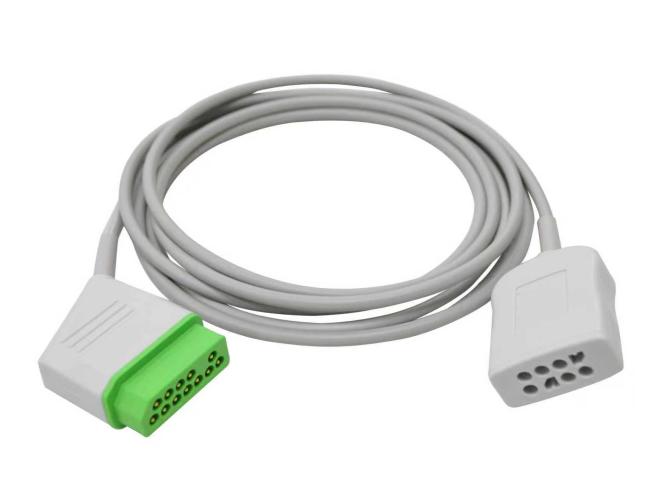
Electrical & Mechanical Characteristics
Conductor: Tinned copper / Silver-plated copper
Resistance: ≤ 1 kΩ (typical)
Capacitance: Low-capacitance design for ECG signal accuracy
Noise Performance: Optimized for motion artifact reduction
Wire Gauge: AWG 30–32
Conductor Structure: Fine-stranded, ultra-flexible
Jacket Material: Medical-grade TPU / Silicone
Outer Diameter: 2.0–2.5 mm (typical)
Bending Life: ≥ 100,000 cycles
Strain Relief: Reinforced at electrode and connector ends
Compatibility: Philips / GE / Mindray / Nihon Kohden / Comen (compatible options)
Technical and specification details
1.Designed for Monitor-Side Applications
Our ECG trunk cables are specifically designed for monitor-side connection, where mechanical stress, frequent handling, and long-term stability are key concerns.
Key design considerations include:
•Secure connection to ECG monitors (EU & US standards)
•Stable multi-channel signal transmission
•High mechanical durability for repeated clinical use
•Compatibility with various ECG monitoring systems
This makes trunk cables ideal for hospital monitors, bedside ECG systems, Holter recorders, and central monitoring setups..
2.Multi-Core Configuration for Reliable and Low-Noise Signal Transmission
To meet different ECG monitoring requirements, our ECG trunk cables are available in a wide range of multi-core configurations, commonly including:
•5-core ECG trunk cables for basic ECG monitoring systems
•7-core ECG trunk cables for 3-lead and 5-lead ECG applications
•10-core and 12-core ECG trunk cables for standard 12-lead ECG monitoring
•High-density configurations such as 15-core or 18-core, supporting multi-parameter or integrated monitoring systems
These multi-core designs allow multiple ECG channels to be transmitted through a single main monitor-side cable, improving system organization while maintaining mechanical durability.
Compliance and Certification
1.Connector Options for Different Monitor Types (EU & US Standards)
ECG trunk cables connect directly to ECG monitors, so monitor-side connector compatibility is critical.
We support a wide range of connector standards, including:
•European standard (EU) monitor connectors
•US standard monitor connectors
•Brand-specific or customized ECG monitor interfaces
Connector design, pin layout, and strain relief are all customized based on the target monitor model to ensure secure connection and long-term reliability.
2.Application scenarios
•Hospital monitors
•Bedside ECG systems
•Holter recorders
•Central monitoring setups
Core Competencies and Differentiation
1.Low-Noise Internal Structure Beyond Shielding
For ECG trunk cables, signal quality is not determined by shielding alone.
To achieve stable, low-noise ECG signal transmission, additional internal conductor-level structures are applied.
Depending on the application, our trunk cables may incorporate:
•Conductive or semi-conductive coating layers on individual conductors
•Graphite- or carbon-based noise-damping coatings to reduce triboelectric noise
•Optimized conductor spacing and core arrangement to minimize cross-talk
•Carefully balanced impedance control across all signal paths
These internal design elements help significantly reduce motion-induced noise and electromagnetic interference, ensuring clean ECG waveforms even in demanding clinical environments.
2.Optimized Core Arrangement for Signal Stability
Each conductor within the ECG trunk cable is precisely arranged to maintain:
•Consistent impedance across channels
•Stable electrical performance over long cable lengths
•Reliable signal integrity during continuous monitoring
This structure is especially critical for hospital monitors, bedside ECG systems, and long-term monitoring applications where signal stability and durability are equally important.
3.Shielding Design for Stable ECG Signals
To ensure clean and stable ECG signal transmission, appropriate shielding is applied based on the system design and monitoring environment.
Available shielding options include:
•Foil shielding
•Braided shielding
•Combined shielding structures
Shielding design is optimized to reduce electromagnetic interference while maintaining cable flexibility and mechanical durability.
4.Built for Durability in Clinical Environments
As a main ECG cable, trunk cables are exposed to frequent plugging, unplugging, bending, and movement.
Our ECG trunk cables are engineered to provide:
•Strong strain relief at connector ends
•High flex-life performance
•Stable electrical characteristics over time
•Consistent quality for long-term and large-volume projects
This makes them suitable for continuous clinical use in demanding hospital environments.
5.Customized trunk cables for specific ECG monitor brands and pin definitions
•Key Technical Features
Connector Type: Brand-specific ECG connectors
Pin Assignment: Customized per OEM specification
Shielding Design: Optimized to meet EMC requirements
Overmolding: Custom mold with logo or part number
•Mechanical Characteristics
Cable Length: Customized
Jacket Color: Optional
Labeling: Laser marking / ink printing
•Application
OEM medical device integration
Replacement cables for branded ECG systems
Shenzhen Qiaoli Technology Co., Ltd. understands that perfect equipment connectivity requires a touch of personalization. Our standard specifications are merely the starting point.
✅ Flexible customization: We can collaborate to meet specific requirements, including precise length, customized color coding, special shielding needs, or compatibility with specific connectors.
✅ Compliance Assurance: All customized solutions are developed under our ISO 13485 system, ensuring full compliance with the stringent standards of the medical industry.
✅ Start with samples: We recommend testing with prototype samples to ensure full compliance with your device integration requirements.
Let us provide you with the most suitable solution.